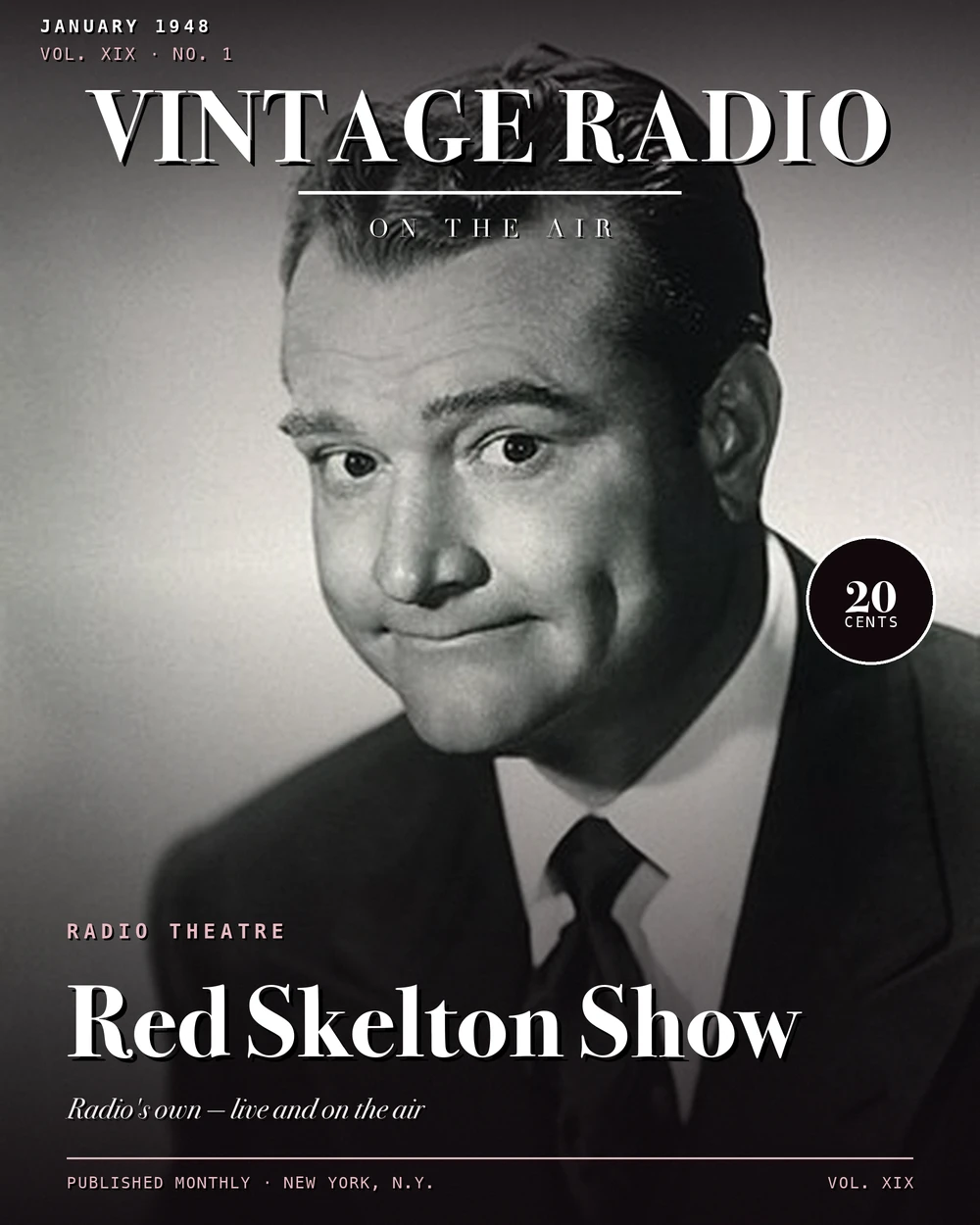
Red Skelton Show
The Least Likely Man on Radio
Red Skelton was a pantomimist. His whole act was physical — the rubber face, the pratfall, the body moving through space. By conventional logic, putting him on radio was absurd. As one assessment of the era put it, Skelton and Edgar Bergen ranked among the least likely entertainers to succeed in the medium, Bergen because he was a ventriloquist and Skelton because his craft was entirely visual. Both had made their first radio appearances on The Fleischmann's Yeast Hour — Skelton's guest slot came on August 12, 1937 — and both eventually became top-ten radio attractions on their own programs. That Skelton pulled it off says something about what he could do with a microphone once he decided to treat it as a tool rather than a limitation.
The path to that first Rudy Vallee appearance had been long and genuinely hard. Skelton was born Richard Bernard Skelton in Vincennes, Indiana, on July 18, 1913 — though he reportedly claimed 1906 himself. His father, Joseph Skelton, a former clown with the Hagenbeck-Wallace Circus, died two months before he was born, which meant Skelton was working by the age of ten. He started in blackface for $15 a week, singing and doing odd jobs. The spark for the larger ambition arrived around 1923, when the comedian Ed Wynn passed through Vincennes; nine- or ten-year-old Skelton was selling newspapers outside the Pantheon Theater, and Wynn bought all his papers and took the boy backstage. Skelton later pointed to that afternoon as the moment he knew what he wanted to do.
What followed was the long apprenticeship. He traveled medicine shows, worked vaudeville, stock, and burlesque, entertained on showboats and the walkathon circuit. As a teenager he worked the same Hagenbeck-Wallace Circus his father had clowned for in the 1890s. By his 17th birthday he was, by all accounts, a battle-scarred professional.
The story of how Skelton got his act into shape involves Edna Stillwell, whom he met in 1930 when he was playing the Pantages Theater in Kansas City and she was an usherette there. She thought his act was "terrible." He thought she was "a priggish snip, and the only thing smart about her was her black-and-white uniform." according to Radio Life. They married in June 1931 anyway, and for seven years afterward they worked obscurity together — tent shows, medicine shows, burlesque, walkathons, riverboats. Stillwell began playing his stooge in small-time engagements, then started writing his routines, and eventually became the architect of the act that made him famous.
The Characters That Made the Show
The radio version of Red Skelton across its run from 1939 to 1953 went through five distinct broadcast periods, two network homes, and several sponsors — but what tied it together was the character work. Skelton built a stable of recurring voices, and the audience kept coming back for them.
Junior, "the mean widdle kid," started as a refined version of a vaudeville routine Skelton had been doing since the early 1930s. The character's logic was simple: Junior would announce "If I dood it, I gets a whipping," pause just long enough, then say "I dood it," followed by the sound of something breaking or going wrong. By the spring of 1942 the catchphrase "I dood it again!" had entered national slang. It spread far enough that when General Doolittle bombed Tokyo that year, newspapers headlined the story "Doolittle Dood It." Junior had other catchphrases too — "He bwoke my widdle arm!" and "He don't know me vewy well, do he?" — that found their way into Warner Bros. cartoons. When MGM used the "I dood it" phrase as the title of a 1943 film without permission, Skelton sought $25,000 in damages from the studio.
Clem Kadiddlehopper was drawn from life — based on a real Vincennes neighbor named Carl Hopper, who was hard of hearing. Clem was described as a singing cab driver, and the character was affectionate in a way Junior wasn't. Years later, Skelton thought the voice of the cartoon moose Bullwinkle sounded close enough to Clem's that he considered suing Bill Scott, who voiced the character; producer Jay Ward reportedly answered by having Bullwinkle deliver a stretch of dialogue in a pointed imitation of Clem. During the second broadcast period, Harriet Hilliard (later Harriet Nelson) played Clem's girlfriend Daisy June and Junior's mother. When Skelton was drafted in 1944, the show paused; when he returned, Daisy June had "married and moved away while Clem was in the service," and Clem's new girlfriend was Sarah Dew, greeted each week with "Well, Sarah Dew, how do you do?" Other characters included Deadeye, described as the "fastest gun in the West" who could fire endlessly at a fly on a wall, blow down the wall, and leave the fly untouched; Willie Lump-Lump; Cauliflower McPugg; Bolivar Shagnasty; and J. Newton Numbskull. San Fernando Red was a confidence man with political aspirations who owned a pair of cross-eyed seagulls named Gertrude and Heathcliffe.
The doughnut-dunking routine that first got Skelton noticed deserves its own mention. Edna Stillwell developed it in 1938 after watching a man dunking doughnuts furtively in a Montreal café. They used it for 26 weeks in Montreal to immediate effect. An American Dunkers Association named Skelton its titular president. He was doing three shows a day, eating a dozen doughnuts in each, and gained 35 pounds. That routine brought him to Hollywood's attention, and in 1938 he was signed to perform it in the Ginger Rogers film Having Wonderful Time for RKO Pictures.
MGM's Star Comedian
The Hollywood part of the story shaped what the radio show became. In 1940 Skelton signed a long-term MGM contract — Mickey Rooney reportedly put in a good word with studio chief Louis B. Mayer — and insisted on a clause permitting radio and television work. Mayer agreed; he came to regret it once television started chewing into film attendance, but the clause held, and Skelton eventually became the only MGM contract player allowed to pursue television as well. The studio affiliation became part of the radio show's on-air identity: announcer Truman Bradley introduced him each week with "And now, here's MGM's star comedian…" One of the studio's uses of him was I Dood It in 1943, largely a remake of Buster Keaton's 1929 Spite Marriage; Keaton coached Skelton through the picture and was so convinced of his talent that he proposed a joint production company to Mayer, who declined.
The Raleigh Years and the Ratings
The second broadcast period, starting October 7, 1941, on NBC as The Raleigh Cigarette Program, was the first real measure of Skelton's radio worth. The Hooper ratings told the story clearly: 28 points within three months, peaking at 40 in the second season. The show was among radio's top five programs, frequently challenging Bob Hope and Fibber McGee and Molly for the number one spot.
The production team behind those years was strong. Ozzie Nelson led the orchestra, and his musical direction was notably inventive — one song title, "Looking for a Guy Who Plays Alto and Baritone, Doubles on a Clarinet, and Wears a Size 37 Suit," gives a sense of the room's sense of humor. Edna Stillwell wrote the scripts. Wonderful Smith, born Floyd Smith, joined the cast in late 1941 playing the role of a cook, billed as radio's "Negro comedy find of the year." His story after that became complicated: he was drafted in 1942, served partly as a disc jockey for Armed Forces Radio Service in Calcutta, India — one of only a handful of African Americans to hold such a position — and when he returned, found his role on the program reduced. In 1947, producers told him he "had difficulty sounding as Negroid as they expected" and his services were no longer required.
The cultural reach of Junior went past slang and into the war effort. In 1943, after a conversation with President Roosevelt, Skelton turned the radio show into a fundraising vehicle, asking children to send in their spare change to help purchase a Douglas A-20 Havoc bomber for the Soviet Army. Two weeks was all it took to raise the money. The plane was christened "We Dood It!"
The show's momentum was interrupted when Skelton was drafted in March 1944. His divorce from Stillwell the year before had cost him his married-man's deferment; his Army induction date was June 7, 1944, the day after his final Raleigh broadcast. Both MGM and the radio sponsor tried to obtain a deferment for him without success. In Italy, Skelton suffered a nervous breakdown, was hospitalized for three months, and was discharged in September 1945. His own summary of his service: "I was the only celebrity who went in and came out a private." When the show ended without its star, it created an opening for Ozzie and Harriet Nelson to begin their own radio program, The Adventures of Ozzie and Harriet.
After the Service
Skelton returned to the air in December 1945, on the same network, in the same timeslot, for the same sponsor. His audience came back within weeks. One study estimated he generated a laugh every 11 seconds on the air. Writer reinforcements came with him: in addition to Stillwell, Jack Douglas, Johnny Murray, and Benedict Freedman contributed scripts during the third period, and David Rose eventually joined as conductor in 1948, having first met Skelton during their overlapping Army service.
Stillwell's footprint stayed enormous even after she was gone. When the divorce was finalized in 1943, she left him three fully prepared show scripts before heading for New York, and she kept custody of the gag file — compiled by a large office staff and said to hold 180,000 jokes. She remained Skelton's financial advisor until 1952 and drew a weekly salary for the rest of her life on the basis of her earlier management work. At the time of the divorce Skelton was generous about it: "Without her I'd still be making ten dollars a week." Arthur Marx's biography records that the generosity didn't last — Skelton grew bitter in later years and eventually denied her existence altogether.
The aftershow that Skelton gave audiences was, by many accounts, the thing people talked about most. His energy during audience warmups was so intense it left the crowd limp rather than primed, so instead he gave them a performance after the broadcast ended. Tickets were hawked by tour guides and recommended by columnists; often as many as 300 people were turned away. The routines included Skelton as a late arrival at a movie theater, tiptoeing through the audience in search of a seat; an "Irish tenor" performing with a loose upper plate and a temperamental accompanist; and the "Guzzler's Gin" sketch, in which Skelton played a TV announcer who drank his sponsor's product, grew progressively drunker, and fell flat on his face. That last routine had started as a sketch called "Mellow Cigars," in which an announcer became ill smoking his sponsor's product; Brown and Williamson asked him to rework it, and the gin version was the result. The aftershow was where Skelton could use visual material that the microphone couldn't carry — work that pointed directly toward his television career.
One production moment from 1947 stands out. On April 22, NBC censored Skelton two minutes into his program while he was discussing the recent censoring of Fred Allen. Both Skelton and announcer Rod O'Connor were silenced for 15 seconds; so was Bob Hope when he joined the topic. Skelton had also been briefly censored the month before for using the word "diaper." His first words back on air after the April silencing: "Well, we have now joined the parade of stars." NBC subsequently indicated it would no longer silence broadcasts for similar reasons.
The Bridge to Television
Skelton's radio run concluded May 26, 1953, by which point his television show — which had premiered September 30, 1951 — was already well established. He had run both simultaneously for two seasons. The television show's first season finished fourth in the Nielsen ratings and won Emmy Awards for Best Comedy Show and Outstanding Writing Achievement; Skelton received a personal Emmy as best comedian.
David Rose served as musical director across the full 21-year television run, conducting 526 episodes. His composition "Holiday for Strings," written in 1941 and first popularized through Skelton's radio program, became the television show's theme. The show ran on NBC until 1953, moved to CBS for the 1953–54 season, expanded to an hour in 1962 as The Red Skelton Hour, and was canceled by CBS in 1970 citing high production costs and demographic shifts. Skelton reportedly was heartbroken at the cancellation.
On television, Skelton found the outlet he had always needed for purely visual work — the mute hobo character Freddie the Freeloader in skits of pantomimic silence was the fulfillment of what the aftershow had previewed. His closing line on television, "Good night and may God bless," became as familiar as any sign-off in the medium. He received 13 Emmy nominations, winning in 1951, 1956, and 1960–61, and a Golden Globe in 1959 for Best TV Show. He was inducted into the Radio Hall of Fame in 1994, the Television Academy Hall of Fame in 1988, and has two stars on the Hollywood Walk of Fame — one for radio, one for television. Red Skelton died on September 17, 1997.